When in 1199 Don Lope Sánchez de Mena , Lord of Bortedo, granted a charter to Balmaseda, he was privileging a crossroads between Santander, Burgos and Álava, which had been very popular with merchants and traders since ancient times.
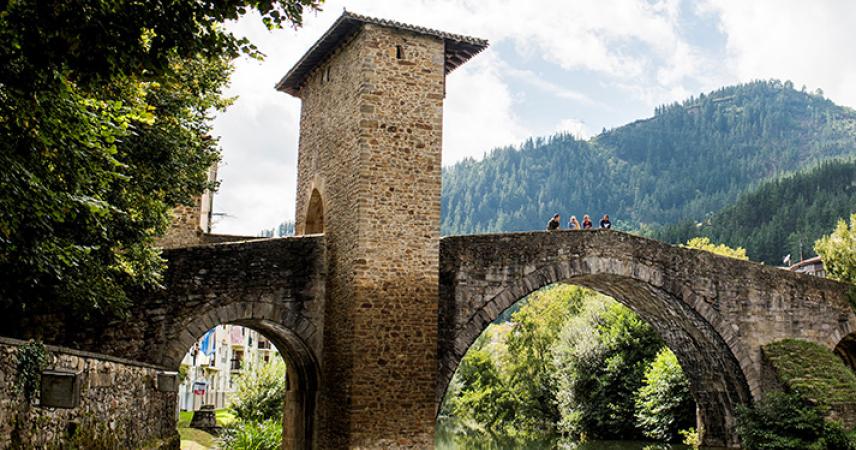
Taking the station bridge and walking along the Martín Mendia promenade we will arrive – flanked by the Kadagua River – at the Old Bridge or Muza Bridge , the quintessential image of Balmaseda, built in the 13th century and an obligatory passage on the old road to Castilla.
On the other side of the bridge is San Lorenzo, the old Jewish quarter of Balmaseda until their expulsion from the town in 1486.
Next, we'll head to the Monumental Complex of Santa Clara , vacated by the nuns since 1985. It has been restored and houses the Hotel San Roque . The Church of Santa Clara, attached to the convent, houses the Balmaseda Passion Play Interpretation Center , and the former preceptory is now a private home.
We'll continue along Martín Mendia Street, better known to the people of Balmaseda as Bajera Street, which will take us to San Juan Square or Plaza de las Escuelas. There we'll find three buildings:
- The Church of San Juan del Moral , founded in the 15th century and currently closed to worship, houses the Balmaseda History Museum . In its tower, a clock plays the town's anthem every day at 12, 6, and 8 p.m.
- The Klaret Antzokia, the former church of the Claretian friars and now a cinema theatre.
- The House of Culture, which houses the library, exhibition halls, an auditorium, and facilities for cultural and sports associations.
A little further on, to the left, stands the Horcasitas Palace . Built in the 17th century, it housed the town's former Royal Customs Office until it was abolished in 1841. In front of it is a sundial that allows the Earth's movements relative to the sun to be observed with unique precision.
Continuing along the same street, we will take the first corner on the left until Correría Street, at the intersection of which is the Urrutia Palace , built in the 17th century and now converted into housing.
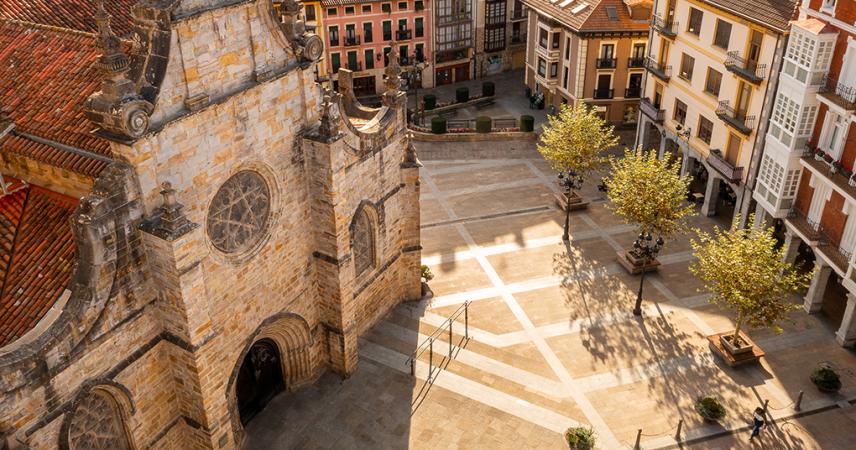
Going down this same street we will arrive at the Plaza de San Severino, the main square of the town, where the church of San Severino and the town hall . The Gothic-style temple dates from the late 14th century. The town hall, on the other hand, was built in the first third of the 18th century, although it bears little resemblance today to the style of the Baroque mountain palace it originally was. Its elegant arcades, with a wide columned portico, have earned it the nickname of the Mosque due to its resemblance to some Mudejar buildings.
The La Encartada Beret Museum , a former factory specializing in the traditional Basque txapela, takes us back to the final stages of the Industrial Revolution. It's located in the Peñueco neighborhood, on the outskirts of Balmaseda, on the banks of the Kadagua River, next to a small recreational area. The factory opened in 1892 and remained in operation for 100 years.
A honking mountain
Finally, nature lovers can't miss the climb up Mount Kolitza . The hike takes approximately an hour and a half and doesn't present excessive gradients except for the final stretch. Kolitza, at 879 meters above sea level and offering perfect panoramic views, is one of the five "horn-horn" mountains of Bizkaia (from where bonfires were lit and horns blown to summon General Assemblies). Its summit dominates Balmaseda and is home to one of the few Romanesque hermitages in the region: that of San Sebastián and San Roque .