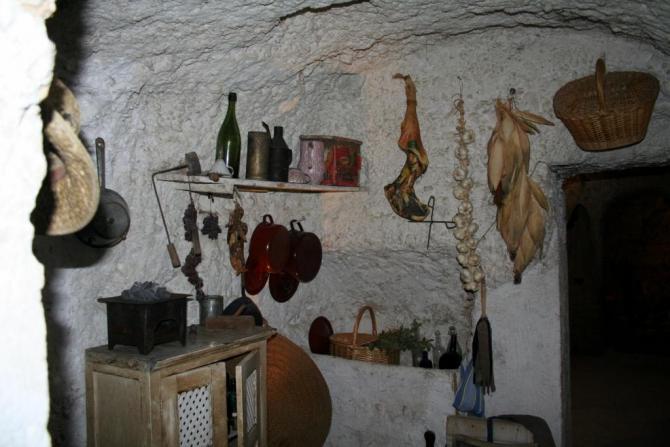
The custom of living in caves goes back to the beginning of time. This kind of home became widespread in the mid-18th century, and in the Tajuña Valley, they were most popular during the second half of the 20th century. Around the 1950s and 60s, it is estimated that about 235 caves were inhabited in Tielmes. This growth was determined by the harsh post-Civil War economic conditions, when this kind of house was relied on by day labourers and small farm owners who could not afford conventional housing.
The construction of these caves began after a siliceous limestone hillside was chosen for their location for its easy to-excavate, stable material. A vertical cut-out served as a facade, reinforced with stonework and a tiled roof. The kitchen was strategically located, playing a central role in removing humidity and distributing heat. The excavated soil was used to create an area of level ground to cover the upper part of the house, which supported the growth of local vegetation and improved insulation.
Nowadays, most of them have disappeared or have been converted into wineries or countryside holiday apartments, fitted with all the facilities of a modern home.
This Cave House, now a museum, has six rooms spread across a front section and a back section. The front section contains the kitchen, entrance hall and children’s bedroom, while the back contains the main bedroom, a storage room and a henhouse/stable.
The entrance ticket is the same for both the municipal museums and the washing place, at the following prices:
General 2 €
Discounted 1 € For groups (Minimum 10 people) and over 65s.
Free For registered residents of the municipality and children under 6
Thursdays, Fridays and Saturdays 10:30 - 12:00 16:30 - 18:00
Summer season: 18:00 - 19:30
Sundays 10:30 - 12:00