Antonio Rodríguez de Hita, born in Valverde de Alcalá on 18 January 1722, was an influential Spanish theorist and composer. With a focus on vocal music, he was central to the revival of the Spanish musical theatre genre zarzuela in the second half of the 18th century.
From a young age, he showed his musical prowess, being appointed chapel master in Alcalá de Henares at the age of 16. He later held the same post at Palencia Cathedral, where he was ordained a priest and composed a significant amount of religious music and theory. During his time in Palencia, Rodríguez de Hita developed an innovative musical style, seen in works such as the Escala diatónico chromático-enharmónica and several religious vocal compositions.
His career reached a high point when he moved to Madrid in 1765, succeeding José Mir y Llusá as chapel master at the La Encarnación Monastery. In Madrid, Rodríguez de Hita ventured into stage music, collaborating with the playwright Ramón de la Cruz. Together, they contributed significantly to t he development of Spanish zarzuela, with works such as Briseida and Las segadoras de Vallecas, which combined heroic and comedic elements with music of remarkable theatrical quality. His zarzuela Scipión en Cartagena was his last major stage production.
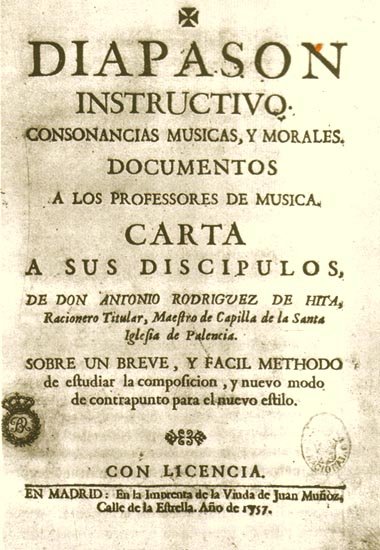
Rodríguez de Hita also excelled in musical education, publishing the treatise Diapasón instructivo in 1757, which influenced musical teaching and composition in Spain. In his later years, he also made great contributions to church music in Madrid, leaving a legacy of religious works that reflect a fusion of traditional style with modern operatic elements.
Despite his death in 1787, Rodríguez de Hita’s remained influential, and appreciation for him was revived in the 19th century by musicologists such as Felipe Pedrell. His work, comprising around 250 pieces, is renowned for its diversity and artistic depth, representing a bridge between the late Baroque musical tradition and the innovations of Classicism.