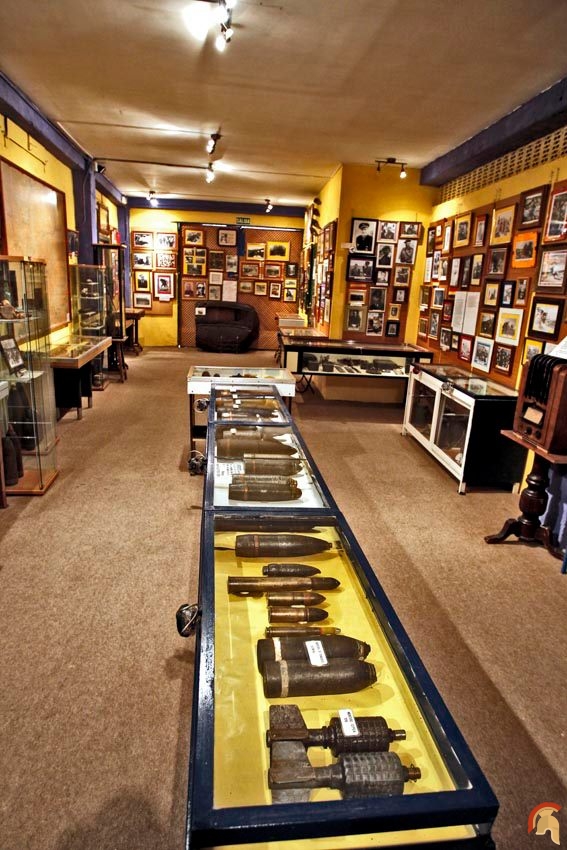
Morata de Tajuña is home to one of the few museums in Spain dedicated to the Spanish Civil War: the Battle of Jarama Museum. A time capsule where you can see hundreds of personal items, safe conduct passes, ration books, maps, photos, leaflets, bullet pierced helmets, mortars, remains of food tins, lighters, weapons, cannons, bottles, newspapers of the period, coins and banknotes. Gregorio Salcedo rescued all this from oblivion in the fields and olive groves near Morata, to pay respects to those families who, like his own, survived the post-war period thanks to the scrap metal left over from the first modern battle in history.
All the objects in the collection, some donated by relatives with sentimental ties to the battle and others acquired by Salcedo himself, provide an overview of the conflict, not just from a military or ideological point of view, but more importantly they show what life was like for the thousands of soldiers on both sides who fought from February 1937 until the end of the war.
A museum that, as its creator says, ‘makes you cry’, but also teaches young generations about a chapter that has been erased from Spanish history, where the historical value of objects, characters and events is shown without any ideological intention.
Milling Museum
In the Tajuña valley, the existence of an important network of hydraulic flour mills has been documented as early as the 12th century. The network was located along the river’s natural course, and was active until the 1970s.
The Huerta de Angulo Mill is one of the mills along the Tajuña that supplied flour to the towns in Las Vegas for centuries. The current building dates back to the early 18th century, although it appears another building existed before it that could be centuries older.
The building had different owners and tenants, known by different names such as as the ‘Abajo’ Mill, or ‘Huerta de la Vega’ Mill when it belonged to the house of Altamira, owner of the Lordship of Morata and of the cloth fulling mill on Taray Island.
In 1888, it was renovated by Diego María Jarava with improved features. This relegated another of the municipality’s artefacts, the Hundido Mill, to abandonment. But it was at the beginning of the 20th century when the Mac-Crohon family extended its premises with a turbine to generate electrical power, which gave rise to the chimney that now sits atop the building and was used until 1984, when it fell into disuse.
The mill was acquired by the Consistory in 1998, another part of the process of recovering the historical, cultural and tourism value offered by the small town of Morata de Tajuña. The Museum is divided into two floors full of machinery, items and milling tools, with signs explaining its operation process.