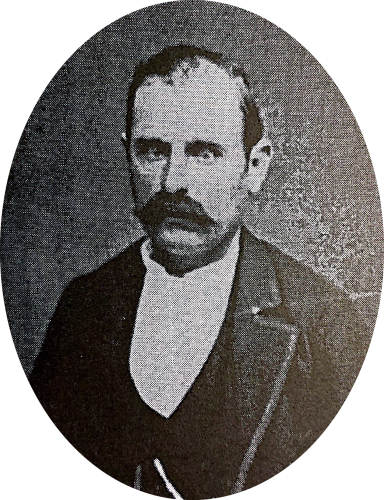
The death of a man, the birth of a legend
Near this place, Manuel Saturnino Almazán, known as ‘The Chaplain’, was murdered at the age of 43 on the night of 15 March 1883. Almazán was a seminarian, farmer, mayor, liberal and bandit, and the story of his exciting life can be read on a board outside the Town Hall. His violent death was the result of envy and resentment, especially among his fellow group members, who were unhappy with his generosity towards the poor.
The confrontation between the Chaplain and his group members led to a deadly conflict. He was ambushed in this alley between Calle Mayor and Calle Palacio by his comrades on the night of 15 March. A companion of the Chaplain alerted the traitors, who attacked him with weapons. In his final moments, Almazán shouted the names of his attackers, in the hope that somebody nearby would hear him. Finally, he died, and the traitors burnt his moustache before leaving him to make sure he was dead.
The next day, on the Friday of Sorrows, a local reported this to the town’s priest, Don Ángel Boyos, who confirmed his murder with outrage. Although someone seemingly witnessed or heard what happened, the killers were never identified, and nobody was sentenced at trial. The Chaplain was buried three days later in the cemetery by the hermitage, and in 1887, his remains were moved to the new graveyard upon payment of 100 Spanish reals.
A wooden cross was placed in the spot where he died, known as the ‘Chaplain’s Cross’, and remained there for many years. Despite his tragic end, the memory of Almazán and his deeds lives on in the banks of the Tajuña, and his name is widely known across the town and surrounding area.