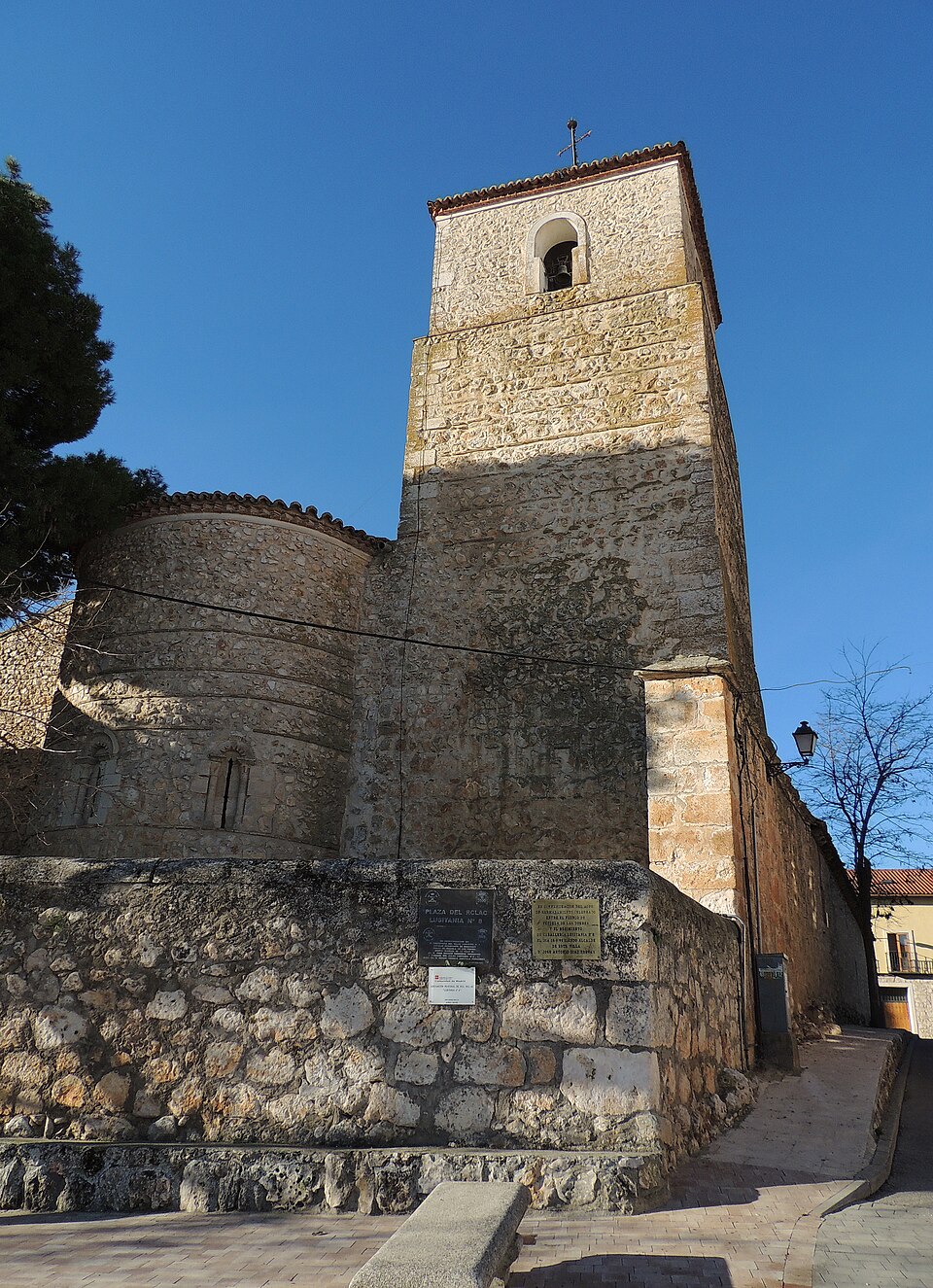
This building is one of the lesser-known medieval monuments, but is perhaps the most intriguing in the Madrid province. Originally built in the 12th century, from this period, the inside of the church still has the Romanesque-style apse windows and anthropomorphic tombs (the kind from Olèrdola).
The medieval apse has a semicircular floor plan and is made of limestone stonework and brick walls, with an upper angled-brick frieze that was clearly later enlarged. The apse wall contains three Romanesque windows, the oldest from the original church, while the central one and the one in the epistle date from the 12th century, having been partly rebuilt. In the central section, there is a flat window that served to let light and air into the church.
The tower, located to the north of the apse at the chancel of the church, is Mendocino style, common in the Alcarria region. With a solid brick interior, it has a square floor plan, with limestone stonework and a pyramid-shaped roof crowned by a cross. The belfry is accessible from inside the church via a stairwell with Mudejar segments. In the 16th century, the second section of the tower was built and the corners were reinforced with ashlars. In 1903, the entire south wall of the tower collapsed and fell on the roof of the church. In 1905, the tower was rebuilt as it currently stands.
Monument to the ‘Dragoons of Pezuela’ Regiment
This square is dedicated to the 8th ‘Lusitania’ Cavalry Regiment, former Regiment of Pezuela, 10th Dragoons, founded in 1709 by Don Jaime Miguel de Guzmán y Spínola, the 6th Count of Pezuela de las Torres. In 1998, the Pezuela Town Council was twinned with the current Regiment.
The 6th Count of Pezuela was an outstanding Spanish nobleman, military officer and diplomat who was born in Seville in 1690 and died in Barcelona in 1767. He distinguished himself during the Spanish War of the Succession, taking part in important battles such as that of Almansa and in the siege of Tortosa in 1709, where he founded a Dragoon regiment.