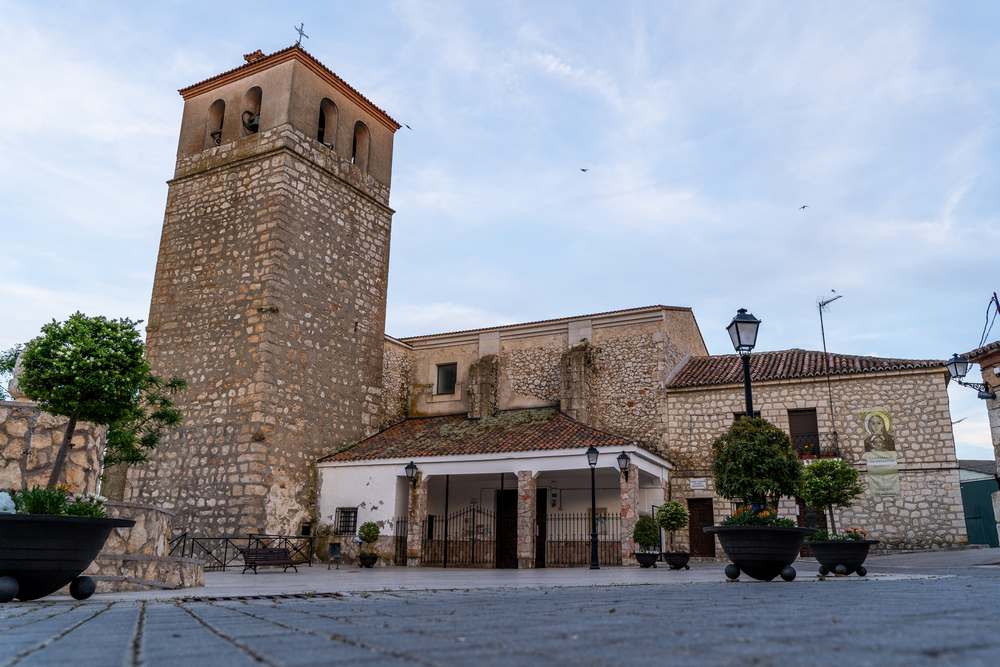
It is not known exactly when the church was built, although the evidence we have suggests that it dates back to the 16th century, being of Renaissance style. Built from carved stone, it had a total of 11 altars and housed artistic pieces of notable value, such as a painting of Jesus Carrying the Cross, by Luis Morales El Divino.
In the Civil War it was sacked and destroyed, before being rebuilt in 1951. Several elements were lost: the chapel of the Holy Christ, the baptistery, the choir gallery, the main portico, which was replaced by a smaller one, and the size of the central nave was reduced due to the destruction of a section that today is occupied by the Parish Office. In short, before its destruction, the church was much larger than it is today.
If you look closely, you will see four carved heads in Romanesque style, which sit in the corners of the tower. On the 15th of May, St. Isidore the Labourer is taken out in procession to the upper part of the town, and the fields are blessed for a good harvest.
The incorrupt body of Francisco de Vera Collantes In the church, beneath the painting attributed to Divino Morales, there was a chest containing the incorrupt body of Don Francisco de Vera Collantes, a nobleman from Corpa. His body could be seen through a glass case. He was murdered by a sculptor, which was likely arranged by someone else, on 8October 1626. Despite his death being slow, taking a whole day, he forgave and even helped his own murderer. Fifty years later his body was found incorrupt and intact, covered by the habit of the Order of Montesa, of which he was a knight. The incorrupt corpse was taken inside the church, where it remained for many years. It is documented that during the War of Independence (1808–1814), French soldiers threw is body from the top of the bell tower. In the 20thcentury, during the Civil War, the body was buried in the back courtyard of the church to prevent it from being destroyed. When the war ended, excavations were carried out to recover it, but the incorrupt body was never found, and has been missing ever since.