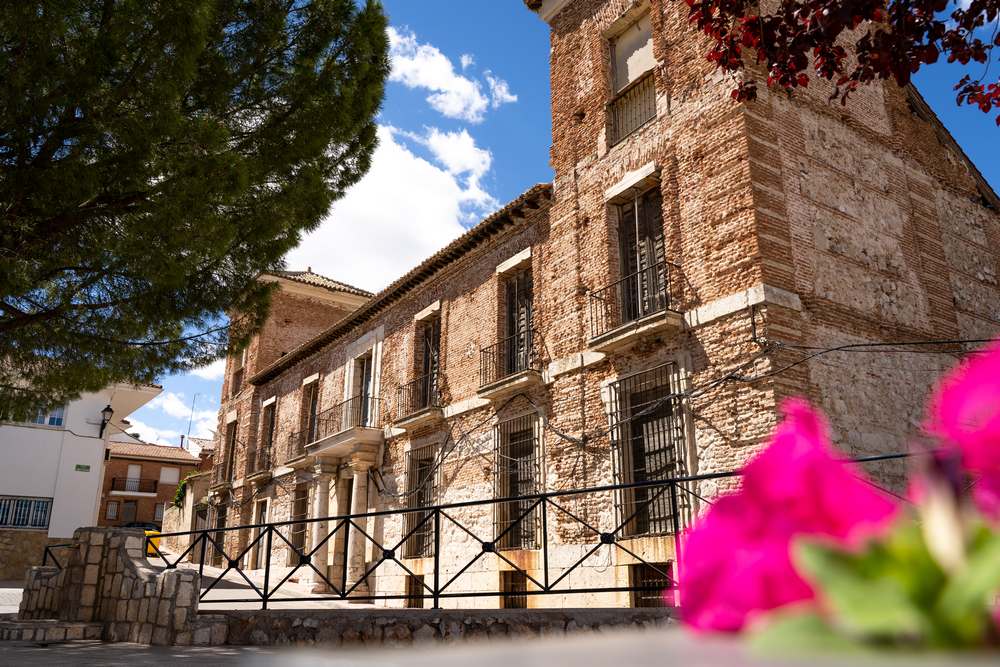
This 17th century palace may have been commissioned by the first Lord of Corpa, Don Mateo Ibáñez de Segovia. Inspired by the formal arrangements of the Palaces of the Madrid Court, the facade has a theatrical sense of urban character that marked the size of the square.
The main doorway is framed between two Tuscan columns on which the entablature of the main balcony on the upper floor rests. It has a basement and two floors with 14 large Baroque-style latticed windows, topped by towers.
Once built, the lord of the town and his escort of nobles were sent to Peru. The palace was finished and the coat of arms of the De La Puente family was placed on it. This was likely placed just above the main portico, under the balcony, although in more recent history it has been believed to be behind the main gate, leaning between the wall and the ground, outside the main facade. It bore the motto of the De La Puente family: ‘We were given death for passing La Puente [the bridge]’.
Besides the coat of arms carved in stone above the portico, references suggest that it housed oil paintings with portraits of the De La Puente family. Another interesting point is that the cellar had large jars inside that needed to be added before the building was finished, otherwise it would not have been possible to fit them in. There are also stories about mid-rise columns at the exit to the garden, where there were also stone sculptures of monkeys.
It may seem unusual to have a building of such importance in a small municipality like ours, but the Lord of Corpa had a close relationship with the Crown. Since he was the owner of the town, he wanted to make it stand out. For the same reason, and by comparing this building with others of the same period, it has been concluded that he commissioned Juan Gómez de Mora to lead the building work. Juan Gómez de Mora was the architect for the Crown and his works include the likes of Plaza Mayor in Madrid.