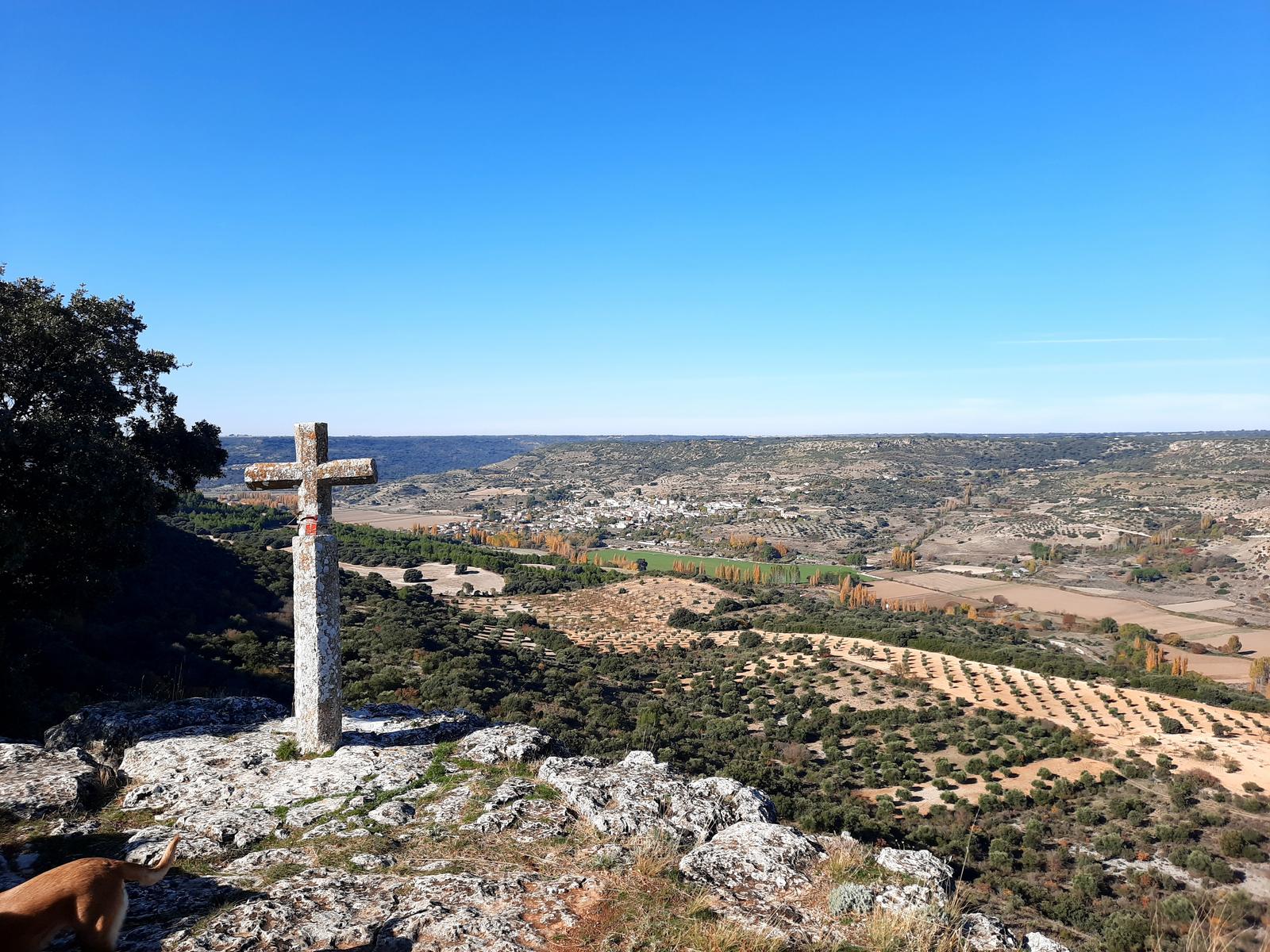
The lands of Ambite, where the landscapes speak of both ordinary life and legends, have given rise to a story that marks the spirit of the town. Legend takes us back to a clear day, when a knight was wandering these parts. The sky, which had been blue and endless until then, was suddenly crowded by dark clouds, the prelude to a looming storm.
The knight frantically spurred his horse in search of shelter from the storm that threatened to tear up the skies. A flash of lightning slashed through the air, causing his nag to panic and run amok into a ravine. But at the edge of the abyss, a miraculous rock stopped his fall; the horse used its last efforts to stick its leg into the rock, leaving an imprint of its shoe.
Overcome by the miracle, the knight, whose heart still was pounding, exclaimed in gratitude: ‘God bless the Cross of Ambite!’ He climbed down from his horse, took some branches from the roadside and put up a cross in that exact spot, a simple shrine of thanks to heaven for his salvation.
He then ran back to the town and gathered the locals to tell them of his experience, and prayed to the Virgin Mary. Moved by this sentimental moment, he vowed to make a pilgrimage to the Holy Land to get a piece of the real Cross of Christ. A year later, he fulfilled his vow, and the relic he obtained is now displayed every 3rd May, on the Feast of the Holy Cross, as a testimony to the power of faith and the miracle that took place that day in Ambite.
Thus, the Cross of Ambite that you can visit today guards a tale of faith, vows and miracles, where each stone and branch seems to whisper stories of those before us who walked these very paths.
History of the Tajuña Train
On 30 July 1886, the narrow railway line that connected Madrid with Arganda del Rey and other towns in the area was opened, which transported both passengers and goods. This route, which would eventually become the Tajuña Railway, was popular among the local population from very early on.
By 1901, the railway reached Morata de Tajuña, gradually expanding the range of transported goods. The line continued to expand down to Colmenar de Oreja in 1903 and Orusco in 1910, but in two separate stretches that split not long after the Morata station. The Morata-Colmenar stretch would not expand any further. The province of Guadalajara was already not far from Orusco and the endless possibilities offered by the railway led to the planning of new destinations, with an ambitious plan to reach Aragón.
But after the Civil War, road transport began to prove quicker and cheaper, which led both the project and the railway service into decline from the 1950s, although one route was kept in service until its closure in 1997.
The purpose of this train was clearly for farming. It transported fruit and vegetables from Vega de Tajuña and also supplied the capital with sugar, thanks to the factory located in La Poveda, near Arganda. The Tajuña train has become popularly known as ‘El tren de Arganda, que pita más que anda’ (The train from Arganda that whistles more than it runs). However, those who lived in Vega de Tajuña knew it as the Rompecepas (Vinebreaker), because of how easy it was for travellers to get off to pick grapes from the vineyards and get back on the train, due to how slowly it travelled.
The history of the Tajuña Train is a testimony of times gone by, a symbol of progress and decline which still remains in the memory of those who saw it pass by, despite it no longer running along the rails that once crossed the valley.