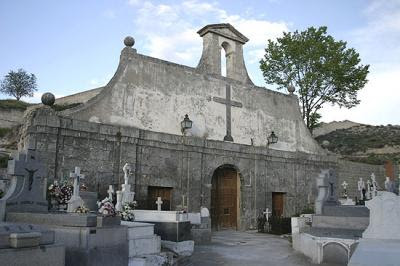
Of the thirteen hermitages and oratories that existed in Estremera during the 16th, 17th and 18th centuries, only the Crypt of the Holy Sepulchre, located in the parish cemetery built in 1833, still remains today.
The chapel was built at the end of the 16th century on the outskirts of the town and consecrated on 4 May 1603 by an auxiliary bishop from Toledo. Its construction was commis sioned by the Brotherhood of the Precious Blood of Christ, to guard the sculpture of Christ in the Selpuchre, who became one of the town’s patron saints. Until a few years ago, the chapel housed the figures of the Recumbent Christ and Our Lady of Solitude, now moved to the parish church.
The church, with a sepulchre design, has a cave-shaped floor plan dug into a hillside. It features three underground naves with stone walls, pillars with semicircular arches, a central nave with a barrel vault and domes, side naves with groin vaults, and a transept with a dome. The outer facade, in Renaissance style, has a door with a semicircular arch, two lintelled apertures, a large cross, several decorative balls and a small bell tower with a pediment.
The design shows influences of the classicist style of Juan de Herrera, architect of the El Escorial Monastery, or of his disciples, such as Juan Gómez de Mora, probably thanks to the mediation of Doña Ana de Mendoza, first Duchess of Estremera and Lady of the Court of Philip II.
Unfortunately, the centuries-old structure collapsed in the 1950s and required complete reconstruction, although the Renaissance facade remained intact. Inside there are several sacred figures carved in the 17th and 18th centuries, which survived the destruction of the Civil War.