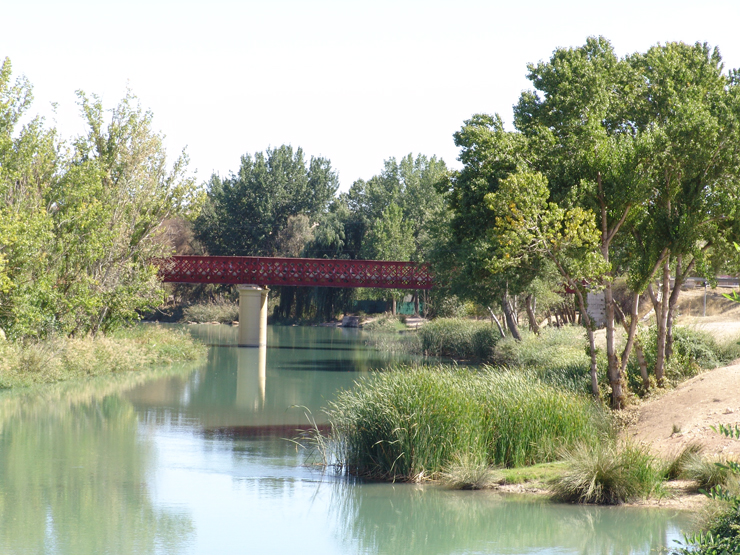
The Iron Bridge
Before the modern times of cars and motorways, this was the natural, main passage to go from Madrid to Valencia, as well as a communication link between the Levante and Andalusia. This bridge is situated right where the first crossing ford was located, which was crossed by a boat and rope, before a rope bridge was built some time later. This path is mentioned in the repertoires of Juan de Villuga in 1546, and those of Alfonso de Menenses in 1576. In the 17th century, it was one of the post roads between Valencia and Madrid, and in the 19th century it became a first-order route between Madrid and Castellón.
The significance of this place as a communication link explains why the Provincial Council of Madrid commissioned engineer José de Echevarría to build a more modern iron bridge, in keeping with the technological advances of the 19th century. Echevarría went to France to commission it, awarding it to the company ‘Imbert y Cia’, which Gustave Eiffel had worked with, hence the bridge is attributed to him. Officially opened in 1867, it was one of the first four iron suspension bridges in the Madrid Region.
Nowadays the motorway to Valencia bypasses Fuentidueña de Tajo just a few metres from here, and we are left with the Iron Bridge, which has become an idyllic spot: a testimony to the crossing of ancient paths full of tales and legends that are lost in time.
River Voyage of Our Lady of Alarilla
2001 — REGIONAL TOURIST ATTRACTION
2022 — CULTURAL HERITAGE ASSET
This unique procession has taken place for over 150 years. Celebrated every year, on the Saturday evening before the second Sunday of September.
Origins
According to the Historical Archives of Alcalá de Henares, on 29 August 1866, the mayor requested permission to use the new rope boat to cross the river with the Virgin of Alarilla, Patron Saint of Fuentidueña de Tajo, on returning from the pilgrimage to the Hermitage, where she appeared to a shepherd boy. Phillip II’s Relaciones Topográficas (Topographic Relations) from 1575 state: “In the fifty-first chapter they said that half a mile from the said town there is a hermitage called Our Lady of Alharilla on the other side of the river’
La Embarcación, our mark of identity
In an almost ritual-like way, the week before the procession, the Festival Committee sets up a boat. The Town Hall organises the event in collaboration with the Hermandad de Ntra. Sra. la Virgen de Alarilla (Sisterhood of Our Lady the Virgin of Alarilla), and the people of Fuentidueña happily take part in the most important event of the year. Every year, thousands of people come to witness our traditional Embarcación de la Virgen de Alarilla (River Voyage of Our Lady of Alarilla). At around 10pm, on either side of the River Tajo, people watch the barge go down the river, decorated with colourful lights and the figure of the Patron Saint going majestically into the night.
Before the boat sets off, a group of young people known as El Tope swim with lit torches, making flourishes in the water. The boat, led by expert rowers and surrounded by swimmers who hail ‘Viva!’ to their patron saint, travels about 800 metres along the river that borders the municipality.
The crowds of visitors excitedly watch the boat go by, some who come to worship and others to enjoy a unique event. To mark the end, a great fireworks display lights up the Iron Bridge and the sky of Fuentidueña de Tajo.