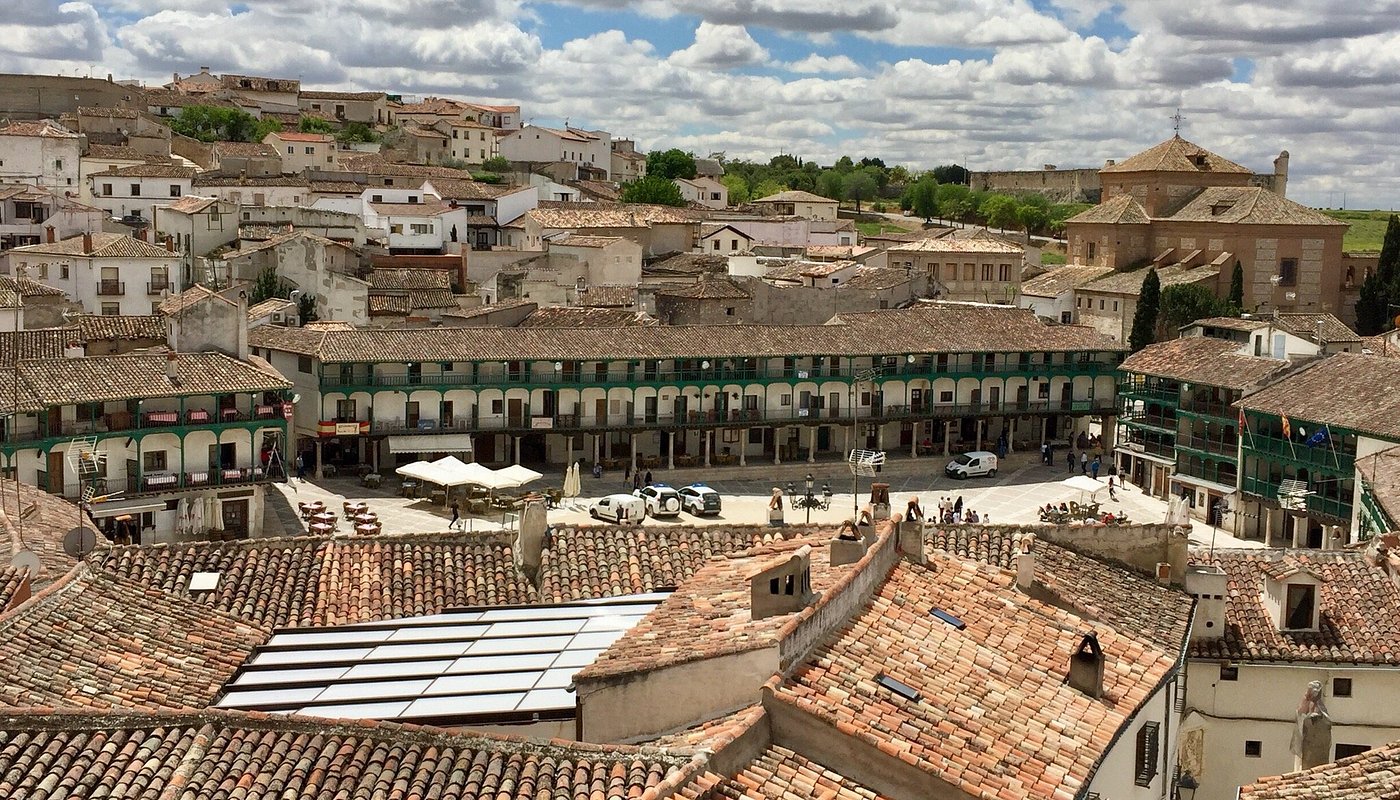
Plaza del Palacio One of the most beautiful views in our city, where you can see the original structure of the town between two hills, with the main square, Plaza Mayor, being the valley that unites them.
Given the location and age of the town, which dates back to the10th century, the whole network of streets and buildings is rather irregular, as it had to adapt to the uneven terrain. We can see the houses are built on terraces on topof each other, creating a spectacular clustered layout.
To our right we can see the olive groves planted by our ancestor son the slopes in this area, some of which are terraced and still provide their best fruit. The main varieties grown in this area are Manzanilla, Cornicabra, Picual and Gordala.
We can also see some vineyards with large, sturdy, goblet-trained vines that are hundreds of yearsold. The grape varieties grown inour town are Malvar, Garnacha and Tempranillo. From left to right we can see several landmarks:
1. Plaza Mayor de Chinchón: It's the town’s main square, in which the earliest buildings date back to the 15th century.Its architectural structure is truly unique and spectacular, and does not follow any specificcanon, as it was built spontaneously by the townspeople. But by no means does this detract from it. In fact, this is what gives it its unique brilliance. One thing the builders did agree on, however, was the wooden balconies, which were used long ago to control livestock kept in the inner enclosure of our square, as its first inhabitants were sheep farmers.
2. The Chain House: A private house belonging to a noble family until recently. During the War of the Spanish Succession, they hosted Philip of Anjou (who would later reign under the name of Philip V). In front of the door, we can see the feature that gives it its name (the chain), placed here as a memento of the King’s stay at this house.
3. Castle of the Counts of Chinchón: the building we see here today was built in the 16th century, although in this very spotthere once stood another that was destroyed in 1520, during the Revolt of the Comuneros. It was well-preserved until the Archduke Charlesused it as a hemp warehouse during the War of the Spanish Succession, which caught fire and affected the entire northwestern part of the castle. In the War of Independence, it suffered its worst when it was plundered and set on fire by French troops who besieged the town for three days. This resulted in the loss of the upper floors. Some of the fallen materials were used to repair roads, fences and houses in the town. It was last used as an aniseed factory.
4. The Augustinian Monastery: The Augustinian Monastery was founded by the Counts of Chinchón in the 17th century. During the War of the Spanish Succession, the Archduke Charles was hosted there. As timepassed, it became a courthouse and later a lodging house
5. The Hermitage of St. Roch: The Hermitage of St. Roch was built in the second half of the17th century, featuring Baroque architecture with brick and masonry walls with recesses. It has two altarpieces, one witha figure of Our Lady of Grace, patron saint of Chinchón, and another larger one with a magnificent sculpture of St. Roch from 1948.
6. The Convent of the Poor Clare: The Convent of the Poor Clares, which began being built in the16th century, although it was not founded until 1653 by the Fifth Counts of Chinchón. It is worth a visit to try the famous biscuits made by the nuns.