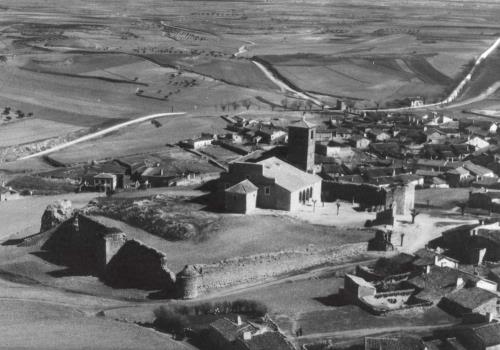
The castle of Santorcaz was a fortress in the stuyle of those built by the warrior monks of the order of Santiago at Fuentidueña and Villarejo: an average-sized enclosure that besides being used as the residence of the lord of the place, i.e. the Archbishop of Toledo, during his sporadic visits to the district, housed various community services including the parish church and the warehouses for storing ítems that the vassals paid in kind as tithes and other forms of rent in Exchange for protection and governance, as well as, probably,, the homes of the agents or servants of the see of Toledo in this remote fiefdom.
This lookout, affording an excellent view of the Carpetan village (3rd.1st century A.D.) that lies opposite, on the Llano de la Horca, is situated precisely on the remnants of the Archbishop’s Palace. As the building crumbled it formed a raised platform. At the foot are the remmants of a second gate, giving direct Access to the residential área protected by two small towers on its flanks.
FROM PALACE TO “CROPPED TOWER”
In the time of Archbishop Pedro Tenorio, i.e. in the mid-14th century, the manorial residence, at first a donjon like that of many other castles, underwent -as was the case in Alcala- major renovation Works to enlarge the private romos and public halls, and became a true palace. The growing affluence of the Archbishop’s court called for them to be lodged in a fitting building. However, this son started to be used for les ceremonial purposes: from the end of the 15th century, the archbishopric used it as a jail for clerics and noblemen in disgrace. Cardinal Cisneros himself was imprisoned there prior to his meteoric rise in the court of kings Isabella and Ferdinand, as was the controversial Pricess of Eboli under Philip II. The building was still standing, albeit in a por state of repair, in the middle of the 19th century, as can be seen in the engraving. Surely that was when it started to be called Torremocha (“Cropped Tower”). The caissoned ceiling of the main hall ended up at the Palace of Laredo, in Alcala, where we can still enjoy seeing its rich Mudejar decoration.