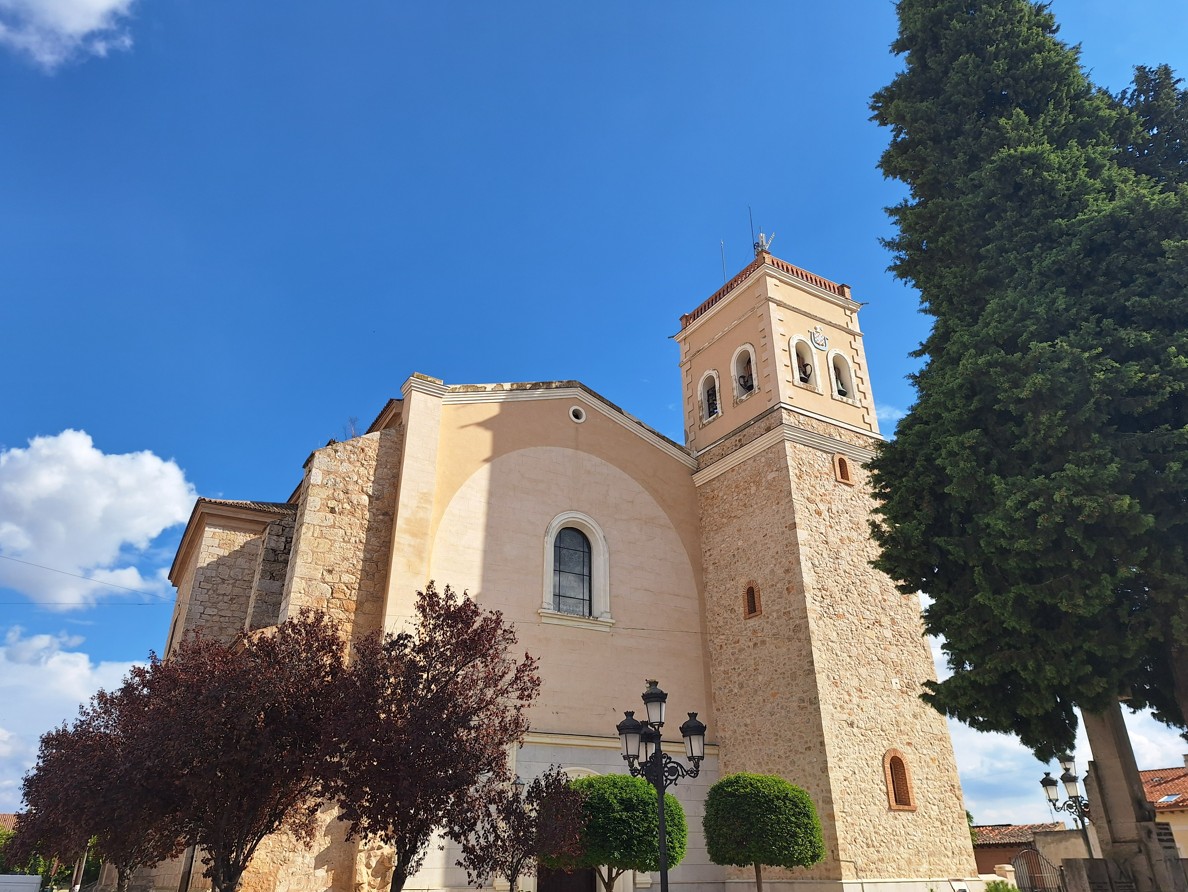
Located in a square that bears its name, the church and its colossal stone bell tower rise over the town of Morata and preside over the Tajuña river plain, making it the prized jewel of Morata’s historical and artistic heritage.
The Church of Our Lady of the Conception was built at the beginning of the 17th century (there are references to it having replaced an earlier church, perhaps medieval). It offers a beautiful visual effect by blending in with all the shades of stone in the landscape and the hills surrounding the Tajuña river plain.
During the Civil War, Morata was very close to the battle front, and was on the Republican side during the years of conflict, which is why it ended up being burnt and partially destroyed.
This meant that, during the 1940s, with the aim of reforming the whole town that collaborated in the work, the church was restored, with certain parts being remodelled.
The legacy of those years is the beautiful front altarpiece, carved in 1956, which consists of six scenes from the life of Jesus, another six from the life of the Virgin Mary, and a niche where the figure of the Immaculate Conception can be found.
The altarpiece on the left-hand side of the church dates back to 1948, and at the other end is the altarpiece of the Risen Christ, next to that of St. Isidore, borded by figures of St. Anthony the Great and St. Anthony of Padua. Throughout the chapels, you will find figures of Jesus of Nazareth, the Christ of the True Cross, the Christ of Medinaceli, the Risen Christ, Our Lady of Solitude, together with the figures of St. Lucy, St. Joseph and the Christ Child, among others.