In the natural setting of the Alcarria region of Madrid, the soils are mainly limestone, or loam and gypsum, with the most arid climatic conditions in the Madrid Region. This has been a very important factor in classifying some groups of plants and animals.
Holly Oak Quercus coccifera
L. Mediterranean shrub of 0.5–3 m with a closely-packed, widespread distribution. Leaves of 1.5–4 cm, rigid, dark green and shiny, with somewhat prickly edges. New leaves, which are bronze and furry, come out in spring together with catkins. It produces acorns with a prickly dome covering half of the fruit. They ripen in their second year among old leaves. They grow on hot, dry scrubland slopes.
Quejigo Quercus faginea
Tree of up to 20 m with a wide crown. The leaves are simple, marcescent, leathery, 3–15 x 1.5–9 cm, oblong to obovate, sinuous/ toothed, dark green on the upper side, with a short fuzz on the underside. It produces acorns with a short stalk. It blooms between March and April, and the fruit ripens in September.
Black Poplar Populis nigra
Tree of up to 30 m with a clear/ fastigiate crown and abundant branching. The leaves are simple, alternating, deciduous, 5–10 x 4–8 cm; the spurs have rhomboid shaped leaves, and the bigger stems have triangular/rhomboidal ovate leaves. It produces oval shaped capsules of 7–9 cm, which are finely granular with four grooves. It blooms between February and March, and the fruit comes out from April to May.
Field Elm Ulmus minor
Tree of up to 30 m with a broad, somewhat sparse crown. The leaves are simple, deciduous, alternating, measuring 8.5 x 6 cm; tapering oval to almost spherical shape, asymmetrical at the base, very acute apex, serrated or toothed edges (1 to 3 teeth), fuzzy or smooth on upper side. Produces round samaras of 20 x 17 mm. It blooms between February and March, and the fruit falls in April.
Roe Deer Capreolus Capreolus
The adult roe deer has a height at the withers of about 75 cm, weighing 20– 30 kg. Males have small, three-pointed antlers. It eats leaves from shrubs and low trees, berries and tender shoots, as well as grass.
European Rabbit Oryctolagus cuniculus
It measures 33–40 cm including its head and body, and its tail is 4–6 cm. It weighs approximately 1.5 kg. It eats all kinds of plants, and especially loves feasting on their buds, leaves, bark, fruits and wild berries, as well as mushrooms.
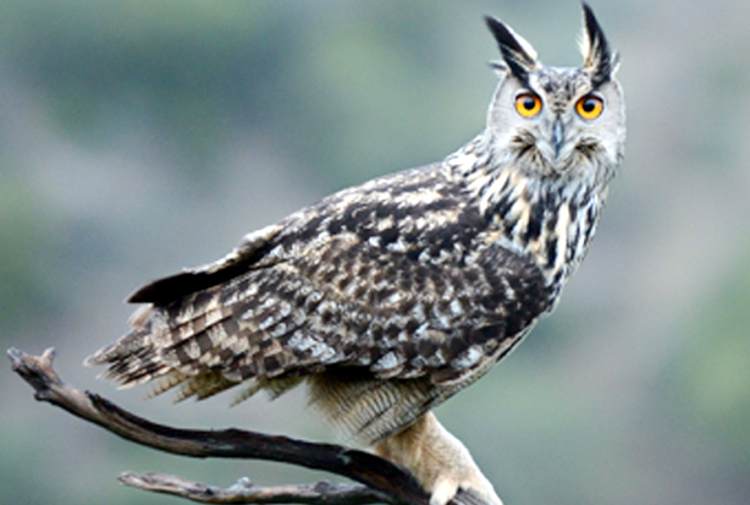
European Eagle-Owl Bubo bubo
The European Eagle-Owl is a sedentary bird with a wingspan of 150–180 cm and a length of 60–72 cm. It lays 2 to 3 eggs, with an incubation period of 32 to 35 days. Males weigh 2,000–2,700 g, and females weigh 2,500–3,200 g. Its diet is based on medium-sized mammals and birds.
Red Fox Vulpes vulpes
The red fox is a discreet animal that hunts, especially at night. During the day they remain hidden among the bushes or in their burrows, dug in dry, hidden patches, often among rocks, grassy ravines and thickets.
Red-legged Partridge Alectoris rufa
This sedentary bird has a wingspan of 33–38 cm and a length of 50–60 cm. It lays 2 to 3 eggs, with an incubation period of 23 days. Males weigh 450–550 g and females weigh 350–450 g. Chicks fledge after 30 days. Its diet includes invertebrates, seeds, nuts, roots.
Wild Boar Sus scrofa
Males are 0.9 to 1.6 m long and weigh 1.55 to 2.65 kg, being more robust than females, which are 0.9 to 1.2 m long. The female’s snout is longer and her tusks are less developed. It is omnivorous, feeding on fruits, tubers, insects, small mammals, eggs, carrion, etc.
Other Animals in the Area: Badger, Stone Marten, Genet, Weasel, Polecat, European Bee-eater, Cuckoo, Barn Swallow, Das tardly Swallow, Swift, Avian, Eurasian Jay, Pere grine Falcon, Bonelli's Eagle, Common Buzzard, Common Goshawk, Eurasian Sparrowhawk, Short-toed Eagle, Common Kestrel, Red Kite, European Little Owl, European Wildcat, European Golden Oriole, Golden Eagle, European Scops, Owl Ocellated Lizard.