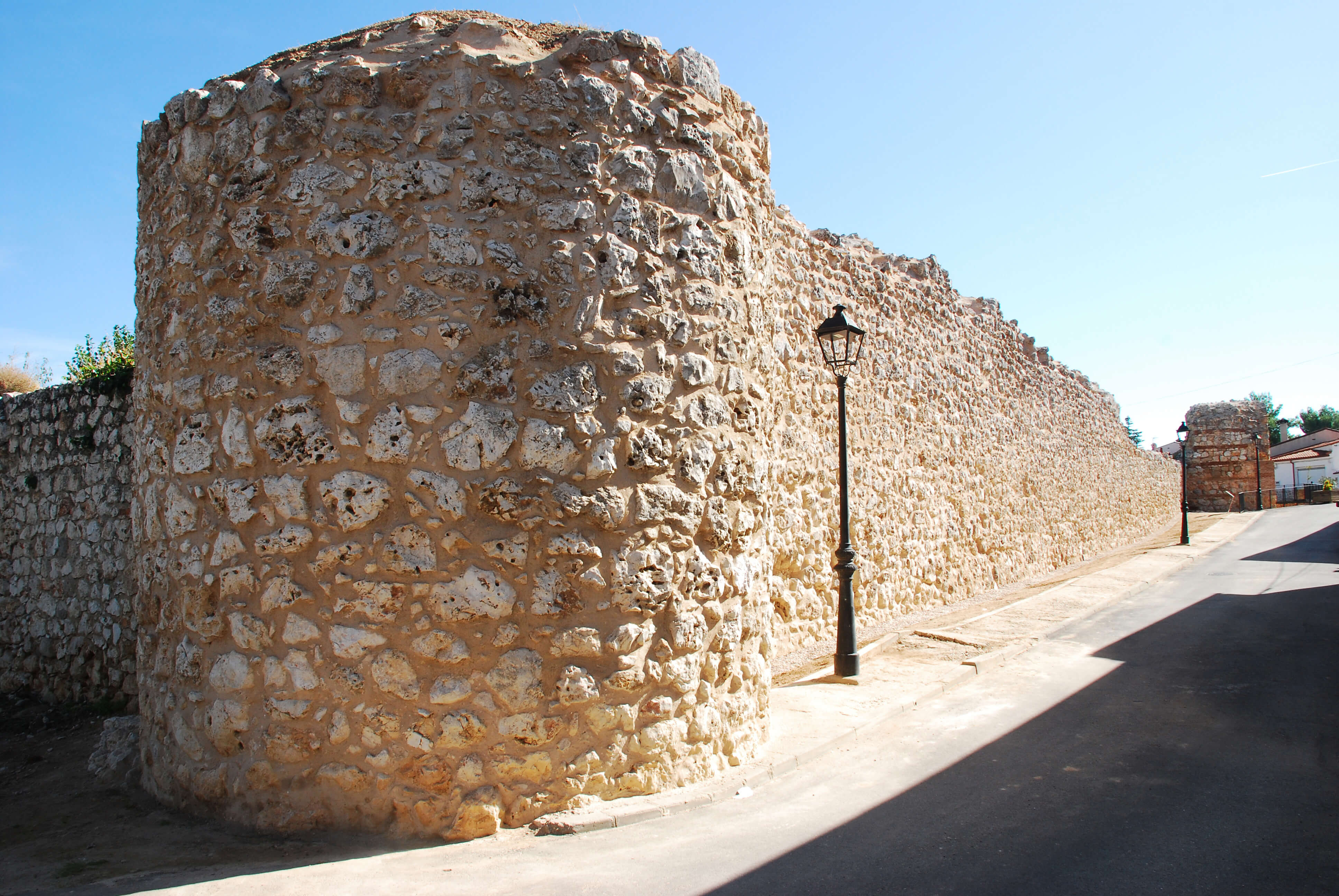
Restoration and refurbishment work on the Torreón del Olivo tower and the south side of the walled enclosure, located in the Torremocha de Santorcaz Castle, has been carried out by the Directorate-General for Cultural Heritage of the Madrid Region. The Castle has been declared an Asset of Cultural Heritage in the Monument category, according to the Spanish Historical Heritage Act (Ley 16/1985).
The exact construction date of the tower and wall is unknown, but studies have revealed that the Castle ruins can be essentially divided into three construction phases:
- 13th c. Construction of the first walled enclosure. Made from rubble masonry: a structure formed by stones arranged in a certain order, varying in size and shape
- 14th c. The building of the Castle is completed. The Torre Albarrana tower and pentagonal tower are from this period. Made of ashlar: small, roughly worked ashlar blocks distributed horizontally.
- 15th c. Refurbishment work on the Castle. The mixed stonework, considered to be the highest quality Mudejar masonry of Toledo, is from this period.
- 16th c. - 17th c Reconstruction and repair. work was carried out, while in the 19th century major demolition work was carried out, and the remains were used to repair areas of the town.
Restoration work
The main goal of the restoration work carried out was to reinforce the tower, which was in a poor state of conservation. This involved the partial reconstruction of the original volume (recovering its historic appearance) and the complete restoration of the remains that had been preserved.
Both the tower and the wall were partially buried by the paving of the surrounding area. The first step was the archaeological excavation that determined the level of the wall’s foundations and the geometry of the tower’s perimeter, at a depth of roughly 1 metre.
These earthworks have led to findings about the tower’s geometry, materials and original construction system. In addition, potential remains of the wall that connected with the pentagonal tower have been identified on the eastern side, while the foundations (footing) of the wall were found on the western side.
The corners of the tower were made of solid brick, and there are still original corbels that formed part of them. In the studies carried out, it was found that the brickwork was laid in brick slips, with alternating rows of brickwork in the corners. The construction system used meant that no bricks had to be cut during laying. The stone used in the coffering is irregular, but the outer face has been carved in greater detail, as can be seen in the original remains.
In the remains of the wall, it is possible to see the different parts that form them. Studies of samples taken have shown a historical difference between the layout, colour and composition of the mortar from the outer masonry layer and that from the central core. These original properties have been taken into account in the restoration work in order to gain a better understanding of the construction system.